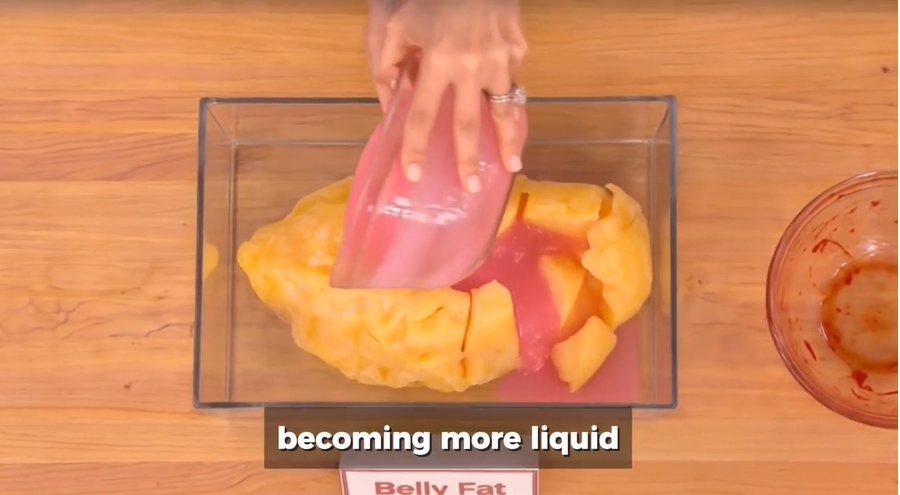
You have counted calories. You have cut carbs. You have followed plans
and pushed through routines that left you exhausted.
And yet — the results never lasted.
If that sounds familiar, know this:
many women report the exact same experience, and researchers are now
studying why conventional approaches may not be enough on their own.
Mayo Clinic (2026): A retrospective cohort study found that women who stored more dietary fat in subcutaneous adipose tissue — and therefore burned less of it — gained significantly more weight over time than those who oxidized more fat. This association was not present in men, suggesting a sex-specific metabolic pattern that may help explain why conventional diets often produce different results in women.
Source: Mayo Clinic / American Journal of Clinical Nutrition, April 2026
- You start the day with good intentions, but by mid-afternoon the hunger becomes hard to ignore.
- You sit down for one thing in the kitchen and end up eating more than you planned.
- You have tried the gelatin method you saw online, followed the steps, and noticed no difference.
- Every time you lose a few pounds, your body seems to rebound — sometimes with more weight than before.
- You feel like your metabolism simply does not work the same way it used to.
These are experiences that many women over 35 share.
Researchers suggest they may be connected to how the body processes
satiety and metabolic signals — processes that can shift significantly with age.
Stanford University / JAMA: A peer-reviewed clinical study found that, in the short term, "gelatin showed stronger hunger suppression and less subsequent energy intake compared with other proteins." Researchers concluded that a gelatin-based protein protocol may promote greater weight loss — but noted that preparation and dosage appear to play a critical role in whether this response is triggered.
Source: JAMA / Stanford University — Peer-reviewed clinical nutrition research
What researchers are exploring: Some studies suggest that
certain changes in how the body produces and responds to satiety-related signals
may make conventional dietary approaches less effective over time.
The gelatin method gaining attention online appears to target this area —
but only when prepared in a specific way.
European Congress on Obesity 2025 (University of Navarra): A 12-week randomized controlled trial found that participants who consumed collagen-enriched protein with water before meals lost twice as much weight as the control group. Researchers highlighted collagen's ability to expand in the stomach as a key mechanism — creating a physical feeling of fullness that may reduce overall food intake.
Source: Nutrients journal / EurekAlert — ECO 2025, University of Navarra, Pamplona
The video below explains what those researchers found, why the version
most people try online may be missing a key step, and what the
complete preparation actually involves.